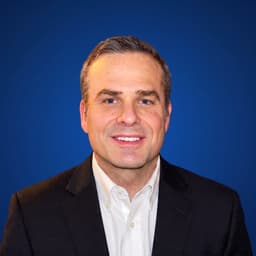
I've run supply chains at Amazon, CVS, and Clean Harbors. Then I spent a year building the AI myself.
Twenty years of operational transformation. More than $100M in realized efficiencies. Since 2025, five working AI systems built from scratch. Engineer, operator, builder.
The Record
in cumulative realized efficiencies
Amazon
$90M+$70M annualized savings via inbound cross-dock network redesign, plus $20M in transportation optimization
Clean Harbors
$50M+Cumulative sourcing and planning savings across 200+ locations through sourcing strategy redesign, vendor rationalization, and full supply chain transformation
CVS Health
$20M+Logistics, distribution, and inventory savings via a total cost-to-serve model built from scratch
Peakview Labs
5 SystemsFive working AI systems I designed and built solo across manufacturing, grocery, healthcare, retail, and automotive, developed with feedback from real companies. Self-directed proofs of concept.
What's Next
What I do best is transformation: an ERP modernization, an S&OP process that isn't working, AI adoption stuck at the pilot stage, a post-acquisition integration. I've done the operational scaling at Amazon and CVS, the enterprise transformation at Clean Harbors, and the hands-on AI building at Peakview.
I do that work two ways. Inside a company, as the executive who owns supply chain and operations. Or through Stratus Supply Chain, for a defined scope: a diligence sprint on a PE deal, an assessment with a 100-day plan, or an interim seat. The principal does the work, and stays through the launch.
For a full-time seat: supply chain and operations at an established operator or a PE-backed company, Boston or remote. For an engagement: industrial, distribution and services companies, fixed scope, fixed fee. Either way, the problem comes first.
If you're thinking about a specific one, I'd like to talk.
Career Arc
Process engineer, supply chain operator, AI builder. Most executives have one of these. The combination is rare.
Scroll to explore the full timeline →Swipe to explore the full timeline →
Case Studies
Enterprise transformations I led, and the AI systems I designed and built at Peakview Labs with feedback from real companies.
The AI Angle
Most executives talk about AI strategy from a distance. I've built it. Five working systems across five industries, designed and built since 2025 with feedback from real companies.
Built It, Not Just Managed It
I have personally architected and built LLM-based agents, real-time data pipelines, IoT sensor integrations, and legacy ERP connectors. That is hands-on engineering, and it changes how I lead the people and vendors who do it at scale.
The Lesson from Peakview Labs
The technology is rarely the hard part. Trust, data, incentive alignment, and human-in-the-loop design are what determine whether AI gets adopted. That lesson came from building, not from a report.
MIT Guest Lecturer
In early 2026, I presented case studies on AI-driven supply chain strategy to MIT graduate students. The ability to teach it means the ability to translate it to any organization.
Technical Stack
How an AI Operational System Works
The human layer is where most AI projects fail. It is where I start.
Supply Chain Intelligence
Current industry developments analyzed through the lens of my experience. Commentary is AI-generated using my background and perspective as context.
Job Fit Analyzer
Paste a job description and get an instant analysis of how my background maps to the requirements. Powered by real-time company research and AI.
Talk to Graham
Ask me anything about my background, my leadership style, how I think about supply chain problems, or what I learned building AI into operations. I will answer the way I would in a real conversation.
Start a conversation or try one of these:
This chat is an AI assistant built on my career context. It speaks as me, and it will say so if you ask. Conversations are logged so I can improve the answers.
Get in Touch
Interested in connecting? Reach out directly or use the form.
Background
Two-page PDFLocation
Greater Boston, MA